Join us on Facebook

My Pet Parakeet | Just another WordPress site

Parakeet Food

Question:

My parakeet keeps flitting [flipping] all the food out of two of the dishes whenever I refill.  I saw her laying in the dish at one time, but only briefly and her activity level has not diminished.  what is going on?

Thanks
Glenna

Answer:

There are several things that could be going on here. I’ll start with the most extreme:

Your Parakeet may be wanting to lay an egg

If she is in fact a female she may be trying to make a nest (you can tell if she’s a girl if she has a brown cere).

If she has a mate then they may have mated and she needs to make a nest. If you think your bird may have mated, get her a nest box and read up on parakeet breeding. You are probably going to have babies.

If she does not have a mate but she has another bird in her cage (male or female), if she thinks you are her mate, or if she has a mirror in her cage then she may think she has mated with the other bird, you, or her reflection in the mirror and now she wants to make a nest.

If you are sure she has not mated, don’t encourage nesting behavior. Parakeets can lay eggs even without a mate if stimulated but egg laying is always hard on their bodies. Make sure she’s getting plenty of calcium in case she does lay an egg.

To discourage her from making and laying eggs, get a smaller food bowl or maybe even a plate that she can’t sit inside of, get rid of any mirrors in the cage, and when you handle her, never touch her vent, under her wings, or her lower back (she may think you are mating if you touch her in these places).

Some people say that shortening her days by covering her cage and putting her to bed earlier will help stop nesting/breeding behavior. This works on other parrots but I have not seen this work with budgie parakeets. You’re welcome to give it a try though.

If you think your parakeet might be egg-bound (she needs to lay an egg but it’s stuck), see a vet right away. You can tell if a bird is egg-bound because she will have a bulge near her vent (butt), and she will be lazy, fluffed up, and usually off balance.

Your Parakeet may just hate her food

She might hate all of her food. This happens all the time when people are switching there birds from seeds to pellets or from one brand of seed to another. Parakeets will flick the food out of the bowl in search of the food they once loved that they used to find in the bowl.

She may like some of the food but not all of it. Parakeets usually pick a favorite food in their food mixture and eat it first. Maybe they like millet or flaxseed the most. They will pick through the seeds or pellets and eat these first. Once they are gone, they will get frustrated and toss everything else out hoping to find at least one more piece of millet.

To fix this, let her get hungry between meals. In the wild, parakeets eat in the morning, sleep in the afternoon, then wake again in the evening to find food again. It is hunger that stimulates them to wake up and get food. You can simulate this but taking food away from the bird at night, giving it back in the morning for a few hours. Taking it out again, giving it back in the afternoon, and taking it out again before bed. A hungry bird is less picky.

Make sure she has access to food for at least 4 to 6 hours a day. You don’t want to starve your bird.

Maybe she’s board and has found a new hobby!

Lucky you, your bird is doing it just for fun. Not only is food entertaining to play with, but it also gets  your attention. As soon she empties her dish, you come and refill it. Could anything be more fun!

If you think this is the case, do what I said above by limiting her access to food to only several hours a day. You should see the behavior start to stop within a few days.

Also, make sure she gets plenty of play time with toys, you, or other birds.

Good Luck!

1 Comment, read and add comments

If you have one parakeet then you should have at least three dishes. One for water, one for dry food (pellets and seeds) and one for fresh fruits and veggies. If you have more than one bird then you should have more food dishes to prevent the birds from fighting over food.

Types of Parakeet Cage Dishes

Dishes typically come in either plastic or stainless steal. I find that stainless still is easier to keep clean because the plastic will scratch easily and bacteria will be able to grow in the scratches.

Cleaning food and water Dishes

Water dishes should be rinsed and refilled every day. Dry food dishes can be simply refilled every day (unless you find drippings in the food) and the fresh fruit and veggie dish should be rinsed every day.

A deep cleaning of all the dishes should be done at least once a week with warm soapy water. Rinse the soap off thoroughly before putting the dishes back in the cage.

We recommend having at least two sets of dishes for your parakeet cage.

Food and water Bowl Placement

Make sure that your food and water dishes can be easily accessed by putting a perch in front (but not above) of them. Some bowls come with a built in perch. Never put a food dish directly below a perch because your bird is likely to poop right into the dish.

Dishes to Avoid

There are many types of dishes available and for the most part you can use what ever type suites your fancy. Some dishes have coverings that are intended to stop your bird from flicking food out of the dish or from pooping into his food bowl. Many parakeets are frightened of these bowls. They don’t like putting their head into a hole because they can’t see what’s going around them. In the wild this would leave them vulnerable to predators. We recommend not using such bowls as they are stressful for parakeets to use and some will simply refuse to eat from them.

No Comments, add your own comment

Cuddle Bone

In almost every parakeet cage at the pet store you will see a cuttlebone (commonly misspelled “cuddle bone”). It’s a little white thing that sort of looks like a mini surf board hanging on the inside of a cage wall. The people at the pet store will all tell you that you must have one for your bird to chew on to keep his beak and nails trim and they will tell you that it’s also needed for your birds health. Why? What on earth is a cuttlebone and what does it do for your bird?

What is a Cuttlebone?

Contrary to popular belief, cuttlebones are not for your bird to cuddle with. A cuttle bone is actually a bone from a cuttlefish (well its more of an internal shell than a bone because cuttlefish are invertebrates and don’t have real bones).

Cuttlefish are squid-like animals that fill their porous chalky “cuttlebone” with gasses to help control their buoyancy in the water. Cuttlefish are considered a delicious meal in many cultures throughout the world but the cuttlebone is not usually eaten. Instead its sold to the pet trade and other industries where it can be either ground up to be put in medicine and toothpaste, or it can be kept whole and placed in a bird cage.

The cuttlebone as a toy

The cuttlebone is also fun for birds to claw at and chew on and helps them keeps their beaks and nails trim. If your bird likes his cuttlebone you will have to replace it every few months with a new one for him to tear to shreds!

Cuttlebone as a nutritional supplement

The cuttlebone is almost pure calcium and also contains large amounts of iodine. Both of these substances are needed for bird health but are rarely found in bird seed that’s purchased at the pet store.

Cuttlebones also contain high amounts of salt which some experts claim can lead to egg-binding in female birds. In spite of this risk, most veterinarians recommend the cuttlebone as an excellent calcium supplement that will help insure that your parakeet has healthy bones, feathers, and eggs.

Wild parakeets never eat cuttlebones of course, but they get calcium and iodine eating grit, dirt, mud, and even bits of shell in the soil where they live. Adding a cuttle bone or some other sort of mineral stone to your birds cage will help him feel more at home.

No Comments, add your own comment

The above photo was taken by Ann Britton who submitted it as a user submitted photo to the ABC. It shows a flock of budgerigars at Boulia in far west Queensland (15 October 2009).

In order to keep your pet parakeet happy it’s important for you understand how these wonderful little birds live their lives in the wild. The more you can make your parakeet’s life resemble the life of his wild cousins, they happier he will be.

Wild parakeets are nomadic creatures (they live there lives flying from place to place) that live in huge flocks found in Australia’s arid outback. This is an environment that is extremely harsh to virtually all living things. In order to cope with the lack of food and water found in their desert home, parakeets have several incredible adaptations that set them apart from other parrots. They are small which helps them live on less food than larger parrots, they can breed all year round (instead of only during certain seasons like a macaw or conure) and they have a speacial gland that allows them to drink salty water without getting sick.  Parakeet bodies are so efficient at using water that if the temperature is cool, they can go up to 30 days without having to drink any water at all (please don’t try this with your pet parakeet).

Social life of a wild Parakeet

Wild Parakeets are never alone. They are extremely social animals that need a friend close by at all times in order to feel safe. On occasion you might see a single pair of parakeets but they usually fly in flocks if 5 or more. If conditions are good they will fly in groups of well over 1000.

Parakeet flocks take off early in the morning in search of grass seeds (their favorite food) and fresh water to drink. Within the flock they mimic each other’s sounds and actions as they go. This is how they are able to learn and teach each other new skills.

Unlike other birds, parakeets do not seem to have any sort of “pecking order” inside the flock. There are no leaders and no servants among parakeets. All are all treated equal within the group. They eat, they select mates, and they find nesting grounds all on a first come first serve basis. Small fights can break out when a bird’s personal space is invaded or when two birds are going for the same seeds at the same time but these fights are rare and the winner doesn’t seem to gain any sort of lasting authority among the flock.

Wild Parakeet Food

The diet of a wild parakeet consists of the seeds of over 20 plants which is an amazing variety for any wild animal. That’s more variety than most people typically get in their own diets. Most of the seeds come from grasses like Astrepla Lappacea.

Wild parakeets seem to be totally vegetarian. They have never been seen to eat insects or other animal foods. They are not picky eaters. They will eat the seeds from virtually any plant they find (as long as the seed is ripe).

Parakeet flocks will feed early in the morning, nap in a tree throughout the day when it’s hot, then go out in search of food again in the late afternoon as the temperature begins to cool once more.

Wild Parakeet Coloration

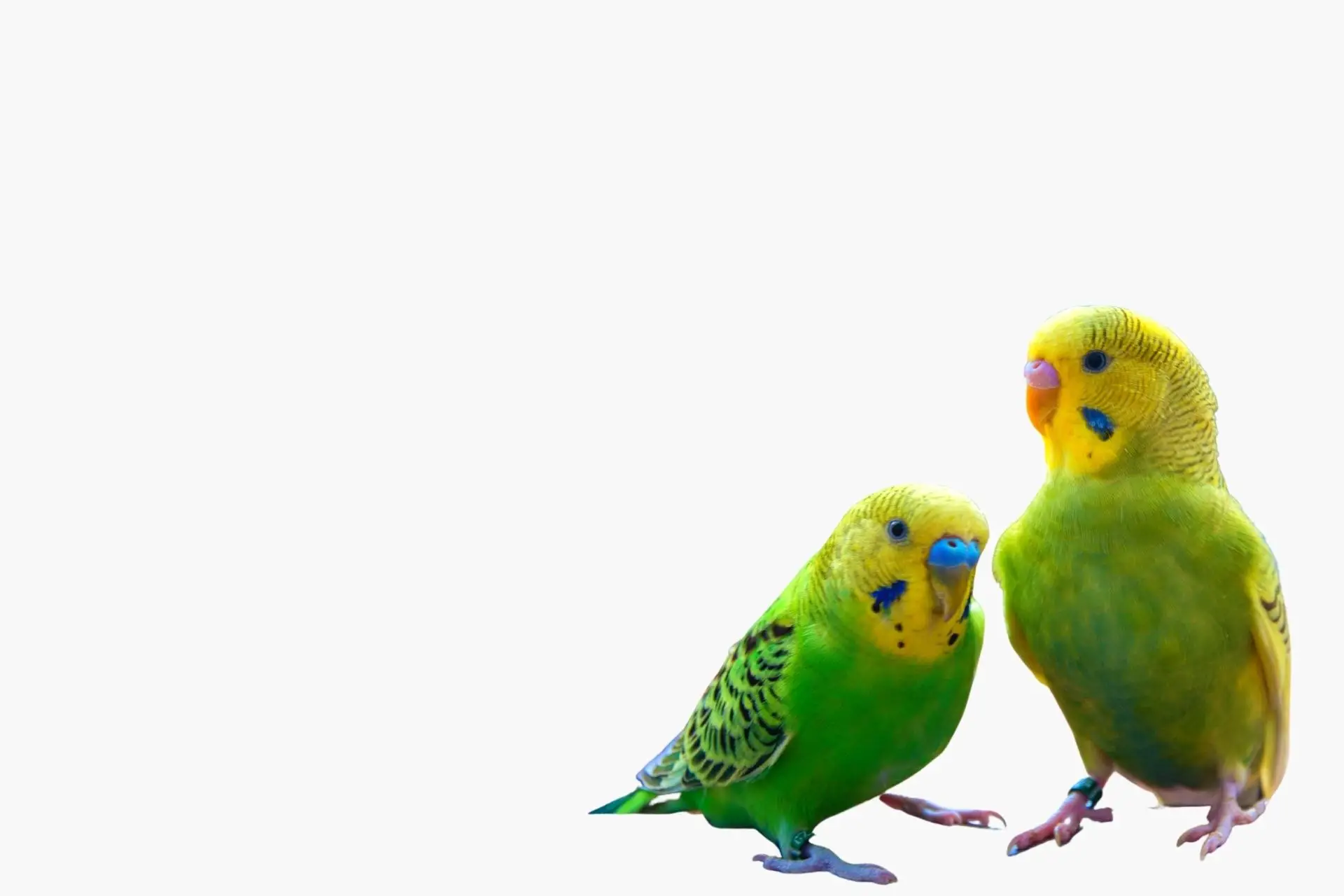
Pet parakeets can come in all shades of green, yellow, blue, and even white but wild parakeets are almost always green with yellow on the face, blue spots on the cheeks, and black stripes on the head and wings. The green coloration helps them blend in with the trees on which they live and the black stripes help them blend in with the rest of the flock to confuse predator birds that may be wanting to attack from above.

The amazing color variations found in the pet trade are the results of careful selective breeding over the past 150 years.

1 Comment, read and add comments